
A building owner buying a 500 kVA diesel generator needs the output available at the site, the fuel demand at the building’s backup load, and a service plan that covers the engine and switchgear. The Enerzip W500D5 and C500D5 share the same reference electrical ratings. Their engines, published fuel consumption and standard sound-attenuated enclosure dimensions differ.
Enerzip Africa Power Solutions submitted a diesel offer for Lot 1 of the LuxDev Rwanda tender A-RWA030-2026-8534. The offer covered six W500D5 sets, with two sets planned for each of three technical and vocational training sites. The C500D5 is included here as an Enerzip product comparison. The tender provides a basis for discussing standby power Generators for schools, offices, hotels, hospitals and other buildings with pumps, refrigeration and distribution equipment that must operate during an outage.
Enerzip W500D5 and C500D5 technical comparison
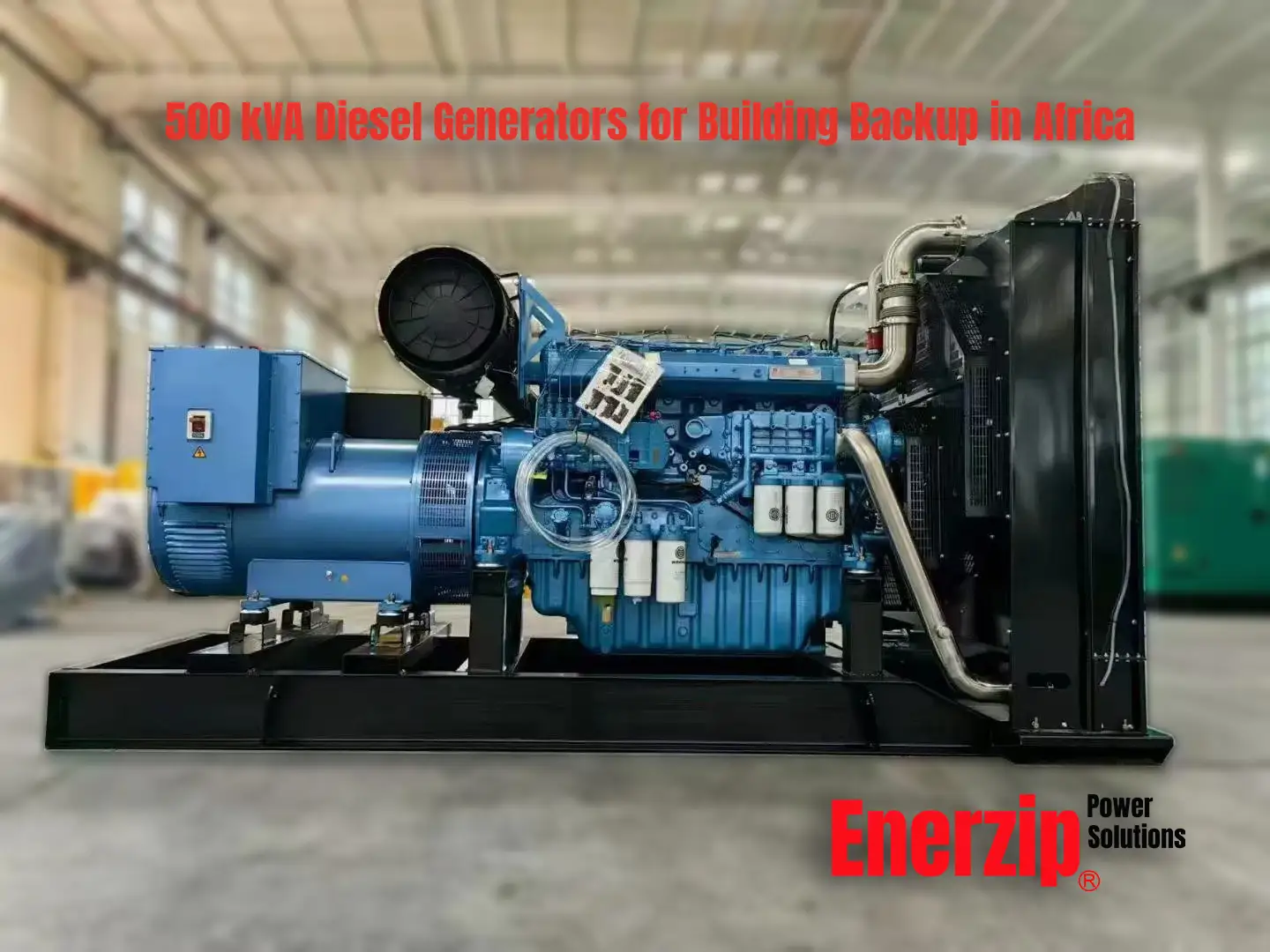
The W500D5 uses a Weichai WP13D490E310. The C500D5 uses a Cummins QSZ13-G3. Both are six-cylinder, turbocharged and charge-air-cooled engines. At 50 Hz the generator sets run at 1,500 rpm, and the data sheets list output ratings at a power factor of 0.8. The figures below describe the configurations in the Enerzip data sheets.
| Parameter | Enerzip W500D5 | Enerzip C500D5 |
|---|---|---|
| Engine | Weichai WP13D490E310 | Cummins QSZ13-G3 |
| Displacement | 12.54 L | 13.0 L |
| Prime power (PRP) | 400 kW / 500 kVA | 400 kW / 500 kVA |
| Emergency standby power (ESP) | 440 kW / 550 kVA | 440 kW / 550 kVA |
| Reference voltage and frequency | 400/230 V, 50 Hz | 400/230 V, 50 Hz |
| Alternator listed | Enerzip STF-400, PMG excitation | Enerzip STF-400 or STAMFORD S5L1D-D4, according to configuration |
| Lubricating-oil system capacity, including filters | 38 L | 45.42 L |
| Cooling system capacity, including radiator | 62 L | 73.1 L |
| Standard silent set dimensions (L × W × H) | 4,250 × 1,550 × 2,180 mm | 4,250 × 1,550 × 2,480 mm |
| Standard silent set dry weight | 4,000 kg | 4,005 kg |
The standard silent W500D5 is 300 mm lower than the standard silent C500D5 listed in these sheets. For an existing building, that difference can affect the route through a gate or loading bay. The approved drawing for the quoted unit establishes the final size, lifting points and clearances. The lubricating-oil system capacities are useful for planning stock. The service refill quantity and change interval come from the instructions for the engine supplied.
Diesel fuel consumption at the same load
The Enerzip data sheets list fuel consumption in litres per hour at four prime-power load points and at full standby power. Comparing the two columns at the same electrical load keeps 100% PRP at 400 kW and 100% ESP at 440 kW distinct.
| Load basis | Electrical output | W500D5 | C500D5 | Difference |
|---|---|---|---|---|
| 25% PRP | 100 kW | 27.8 L/h | 26.0 L/h | 1.8 L/h |
| 50% PRP | 200 kW | 51.0 L/h | 48.9 L/h | 2.1 L/h |
| 75% PRP | 300 kW | 75.3 L/h | 74.2 L/h | 1.1 L/h |
| 100% PRP | 400 kW | 109.5 L/h | 101.5 L/h | 8.0 L/h |
| 100% ESP | 440 kW | 123.1 L/h | 105.5 L/h | 17.6 L/h |
At 400 kW, the C500D5 data sheet lists 8.0 L/h less, about 7.3% below the W500D5 figure. At 300 kW the listed difference is 1.1 L/h. Both data sheets state a fuel-consumption tolerance of +3%. These are reference data sheet values. Budgeting for a particular building starts with its actual outage hours and load profile, then applies the relevant consumption figures or agreed test results.
For fuel storage, use the required running time at the expected load and confirm the tank’s usable fuel volume. A building with a staged restart sequence may spend much of an outage below full prime load. A site running pumps and refrigeration together may operate at a different load for much of the same outage. Those operating hours matter more to the fuel budget than a comparison at full standby power alone.
What Enerzip submitted for the Rwanda tender
LuxDev’s ISHEMA tender called for six 500 kVA generator sets to support training, agro-processing, refrigeration and water systems at Mutobo, EAV Gitwe and Kinazi. The revised Enerzip offer specified six sound-attenuated W500D5 sets and equipment for automatic transfer and paired operation at the three sites. The reference standby rating was 550 kVA per set, and the offer addressed the specified 500 kVA / 400 kW net standby output at the site, subject to certified derating. The tender also specified 450 kVA / 360 kW net prime output per set.
| Part of the Lot 1 offer | Scope submitted |
|---|---|
| Diesel generator sets | Six W500D5 silent sets, two per site |
| Synchronising and load sharing | Three 1,600 A, four-pole panels, one per site, with two generator incomers and kW/kVAr load sharing |
| Transfer and site interface | Three interlocked 1,600 A, four-pole ATS or microgrid interface panels for combined generator output |
| Acoustic requirement | Up to 75 dB(A) at 7 m at 75% load, with evidence to be supplied for the offered configuration |
| Testing and handover | Factory and site testing, commissioning, operator training and handover documentation |
| Initial spares and technical support | Initial service parts and consumables for 2,000 operating hours or two years, plus the warranty and after-sales arrangements set out in the offer |
High elevation, ambient temperature and enclosure airflow affect the output a set can deliver. The Rwanda specification required selection for site altitude and 40°C ambient conditions. Factory nameplate ratings provide the reference. Certified derating and the agreed site tests establish the project rating and performance.
Lot 2 was separately procured and covered enabling works such as foundations, cable routes and external fuel infrastructure. The Lot 1 package still had to interface with those works. At each school, the two generator outputs were to be coordinated through the synchronising board and the agreed transfer or microgrid interface. That affects the switchboard layout, protection, controls and testing as much as it affects the generator selection.
Building loads and the transfer sequence
For a building retrofit, the load schedule should identify the circuits on the proposed standby board, the motors that start automatically and the equipment that comes back on together after power is restored. A water booster pump, lift or refrigeration compressor can be a larger starting load than its normal running current suggests. The electrical designer also identifies any fire pumps, smoke-control equipment and other life-safety circuits with separate requirements for transfer and restoration.
On a single-generator installation, an automatic transfer switch starts the generator after the configured mains-failure delay and transfers the connected load once the generator voltage and frequency are within limits. When the utility supply is stable again, the switch returns the load to utility power and the engine runs through its cooldown period. A UPS can bridge the transfer interval for equipment that needs continuous power.
For a two-set installation, the sequence also needs to define when the second set is called, how the sets share load once both are online, and how the site responds if a set is unavailable. These steps should appear in the operating description and the commissioning test schedule. The Rwanda offer addressed this through a synchronising and load-sharing panel at each site.
What the W500D5 factory load record shows
A W500D5 production test record dated 28 June 2026 gives the following readings from a load-bank test at the Enerzip factory in Weifang. The set in that record used a Weichai WP13D490E310 engine, Enerzip STF-400 alternator and SmartGen HGM9510N controller. This is a factory record for a separate production unit. The Rwanda offer provided for its own factory and site acceptance work.
| Recorded load | Electrical output | Duration | Voltage | Frequency |
|---|---|---|---|---|
| No load | 0 kW | 10 min | 401 V | 50.03 Hz |
| 25% PRP | 100 kW | 15 min | 401 V | 50.02 Hz |
| 50% PRP | 200 kW | 15 min | 400 V | 50.00 Hz |
| 75% PRP | 300 kW | 30 min | 400 V | 49.99 Hz |
| 100% PRP | 400 kW | 60 min | 399 V | 49.98 Hz |
These are individual recorded readings at each load point. The full-load record also lists 89°C coolant temperature and 4.1 bar oil pressure. Site acceptance adds the building and switchgear interfaces that a factory load bank cannot demonstrate on its own, including paired operation, actual transfer sequences and the agreed alarms and interlocks.
Initial maintenance parts, training and warranty
The Rwanda submission included a schedule for 2,000 hours or two years of initial maintenance consumables. It listed a first-service kit at 50 operating hours at no charge for each of the six sets. The kit covered the oil filter, fuel fine filter, fuel pre-filter and fuel pre-filter/water separator. The separate lubricant calculation used the W500D5 data sheet’s 38 L oil system capacity and allowed 1,140 L for the six sets for procurement planning. The final refill quantity and service intervals follow the applicable Weichai instructions.
| Service item | Commitment in the Rwanda offer |
|---|---|
| Operator and maintenance training | At least six people per school and a minimum of three working days, with classroom and hands-on instruction |
| Training records | English materials, attendance records, competency assessments and certificates |
| Refresher training | Remote sessions planned at six and twelve months after Provisional Acceptance |
| Project warranty | 24 months from Provisional Acceptance or 2,000 operating hours, whichever occurs first |
| Initial consumables and maintenance labour | Initial parts under the supply package, with a separately priced two-year scheduled maintenance service |
| Long-term parts | Genuine spare-parts availability for a minimum of ten years from delivery under the manufacturer’s undertaking |
The training plan covered manual and automatic operation, synchronising, the ATS or microgrid interface, routine checks, alarms and emergency shutdown. That scope gives site staff a way to record a fault and isolate the affected function before the service team attends. The warranty terms above are specific to the Rwanda tender offer.
Under the Rwanda offer, covered warranty defects included the necessary parts, labour, travel and testing. The separately priced scheduled maintenance service covered planned inspections, OEM-prescribed labour and service records. Routine consumables for that service line were handled through the initial spares and consumables schedule and subsequent parts requirements. These line items help a facilities manager identify what comes with the equipment, what is covered by warranty and what needs a maintenance budget.
After-sales support from Enerzip Africa
Enerzip Africa Power Solutions is based in Zomba, Malawi, with regional service coverage in Malawi, Mozambique, Tanzania, Zambia and Zimbabwe. The Malawi team coordinates installation and commissioning, receives fault reports and arranges maintenance and spare parts. Enerzip’s manufacturing team in Weifang supports technical escalation, configuration checks and parts identification. contact. The plan called for authorised service personnel and workshop capability in Rwanda or the East African Community. The Rwanda plan set out response commitments by fault severity.
| Fault classification | Remote technical response | On-site attendance |
|---|---|---|
| Critical | Within 4 hours | Within 48 hours |
| Major | Within 8 hours | Within 3 working days |
| Non-critical | Within 1 working day | Within 5 working days |
The plan assigns a service reference and coordinator to each fault and calls for a written report after a site visit. The operator can then trace what was reported, which parts were fitted, and the checks made before the set returned to service. Enerzip’s supply reference list also includes W500D5 school standby installations in Indonesia, the Philippines and Kazakhstan, hospital standby installations in China, and a retail backup power project in the Philippines.
Information needed for a building standby power quotation
Send the building location, site altitude and maximum ambient temperature, voltage and frequency, single-line diagram and standby load schedule. Include the starting method for large pumps, lifts and refrigeration compressors, the required running time before refuelling, and any restriction on the enclosure height or noise at the site.